
Simi Valley Previous Residents Sources
Previous residents of one Simi Valley address appear in separate record layers. Deeds answer title questions, census schedules answer an enumeration-date household question, and directories answer a publisher's listing question.
| Source | Years It Covers | Where Held | What It Shows |
|---|---|---|---|
| Ventura County parcel GIS | Current service; historical depth not guaranteed | County Public Works GIS viewer and parcel layer | APN, situs, map symbols, and latest document clues |
| Recorder deeds and index | County formation era to present; exact web cutoff not published | Ventura County Clerk-Recorder counter, index, and copy channel | Grantor, grantee, legal description, and recording history |
| Ventura court and probate files | Unlimited cases searchable by staff from 1873; older files may be on microfilm or off site | Ventura Superior Court Records Department | Estate, heir, ownership-dispute, and case chronology |
| Federal population census | Public through 1950 | NARA, library databases, Ancestry, and FamilySearch | Enumerated occupants and household relationships |
| Directories and criss-cross sections | Exact Simi years not officially located | Simi Valley Library, Ventura County Library, Museum, and Historical Society | Listed adult, address, phone, and publisher clues if held |
| Permits and City Clerk annexations | Exact online start not published | Simi Valley Planning/Building and City Clerk files | Construction chronology and jurisdiction changes |
Start with the parcel for a building question, the census or a directory for a dated household question, and probate or a successor deed for a deceased owner. Exact reverse-directory years, a local printed run, and Simi-specific Sanborn coverage remain unverified.
Freeze the Simi Valley Parcel
Before opening a deed index, freeze the address as durable fields. In the Ventura County GIS viewer, save situs, APN or APN10, tract, map, book, page, block, parcel, and latest DOC_NR, DOC_DT, and DOC_TYPE. Record the date and adjacent APNs.
The public parcel layer has rich geometry and document fields, but no owner name or mailing address. Assessor web data has statutory limits. The Tax Collector separately handles current, delinquent, unsecured, and supplemental roll inquiries or data products. A situs address identifies land; a tax mailing address identifies notices; neither proves occupancy.
Note: The APN and DOC_NR launch a previous-resident search, not a complete parcel history.
Trace Simi Valley Deeds Backward
A recorder grantor/grantee chain works backward from the latest confirmed conveyance. Use the parcel layer and the Ventura County Clerk-Recorder, then read the legal description rather than trusting a street number. The exact public web cutoff was not stated, so an online stop does not prove earlier deeds are absent.
- Normalize the address and capture the APN, legal-map fields, and latest document number and date.
- Obtain the vesting deed or latest instrument, then inventory parties, capacity, dates, and legal description.
- Search the present grantee as a grantee in an earlier date span to find that party's acquisition.
- Take the earlier grantor and search that party as grantee, confirming the same tract, lot, block, or legal description.
- Separate deeds of trust, reconveyances, quitclaims, trustee deeds, and executor deeds from ordinary conveyances.
- When the web route ends, request older index books, microfilm, or a bounded counter search by date, party, APN, and legal description.
- Grantor
- The party transferring a recorded interest.
- Grantee
- The party receiving that recorded interest.
- Chain of title
- The linked sequence of recorded interests that connects a present conveyance to earlier ones.
- Legal description
- The tract, lot, block, parcel, or metes-and-bounds wording that identifies land more reliably than a changing address.
Simi Valley Parcel Splits and Ghosted Lots
Assessor maps carry symbols that matter across a parcel split. Read book, page, parcel, tract, lot, and block together. Ghosted lots show changed boundaries; adjacent book-and-page references can point to a parent map; a land hook can show one unit divided by a road or channel.
Follow the parent legal description when an old deed predates the current APN. A new APN marks the current assessment system, not the beginning of the land's history. Compare the recorded map, document number, date, and full description. For a condominium, common area, flag lot, or multi-parcel site, state which interest the address represents.
Simi Valley Permits and Annexation Clues
Permits date the physical address. Construction, final inspection, addition, or unit records can explain a missing listing or later multiple interests. Applicant, contractor, project number, and date fields describe a project role, not a full address list.
Simi Valley incorporated in 1969. Before then, roads, permits, and land-use files were county matters; after annexations, City Clerk and city departments accumulated deeds, agreements, and annexation records. Test the Cities layer, then ask the Simi Valley City Clerk for the existing series matching the date and APN. Unincorporated properties may lead to Ventura County Resource Management Agency records.
Simi Valley Previous Residents
For a previous residents trail, a deed identifies a recorded interest on a date, not who occupied the address. The household layer comes from a reverse directory, census, newspaper, yearbook, community record, or permit clue. A tax mailing address may belong to a trust, manager, business, agent, or different parcel.
Use a directory for a publisher's street association, a census for an enumeration-day household, a permit for a project applicant, and a newspaper or obituary for a public connection. Label each finding “held title,” “received tax mail,” “listed at,” “enumerated at,” or “applied for permit.”
Lawful use. Use previous-resident research for house history, family history, heir work, and personal curiosity. Do not stalk, harass, threaten, or expose a protected person.
Ventura Court and Estate Clues
There is no Simi Valley municipal court. Ventura Superior Court separates Civil, Probate and Small Claims; Family Law; and Criminal and Traffic inquiries. Family entries begin September 1, 1991; municipal criminal and traffic data begins January 1, 1989; felony data is tied mainly to the 1995 consolidation. Staff can search unlimited cases back to 1873, with older files on microfilm or off site.
For historic retrieval, copy rules, and mail details, consult the Ventura Superior Court records guidance before requesting a file.
The court source can show probate petitions, heir notices, ownership disputes, and case chronology, but the online result is not the official file. Confidential, sealed, juvenile, adoption, and protected family material may be absent.
Close an estate trail by comparing the probate docket, obituary or death record, and successor deed. A petition may state a relationship; the recorded instrument shows a later transfer. Distinguish a filing allegation from a court finding.
Simi Valley Previous Residents Census Pairing
The newest public census is 1950. Simi Valley Library and Ventura County Library can identify books, microfilm, databases, and reference holdings; the Museum and Historical Society may hold donated material. Exact printed and reverse-directory years were not located, so ask for title, coverage, publisher, call number, and street section.
For the local-history fallback, use the Ventura County Library local-history service, which describes books, microfilm, and in-branch Ancestry Library Edition.
Pair a directory near April 1, 1950 with the census enumeration district, then repeat with 1940 and earlier schedules. Compare address, relationships, age, birthplace, and occupation. Browse the street sequence when OCR or spelling fails.
- Write the directory title and coverage before copying an entry.
- Record street, name spelling, household clues, and page.
- Find the matching census enumeration district and inspect the address sequence.
- Label each difference as a move, lag, omission, changed place name, or conflict.
The Simi Valley city directory collections record supplies the method; the address trail stays with the parcel and deed.
Simi Valley Previous Residents Heir Trails
Probate, obituary, and successor-deed records form a human-use trail after an owner's death. Start with the estate name, petition and notices, then compare an obituary or cemetery lead with a Recorder deed by the estate, executor, administrator, trust, or successor.
The Historical Society at Strathearn adds local context. Founded in 1964 after the 1968 property gift, it preserves pioneer photographs, letters, objects, and buildings. A family file can explain a name or ranch connection, but it is not title proof.
Use the Simi Valley Historical Society and Strathearn information to check public hours and research access.
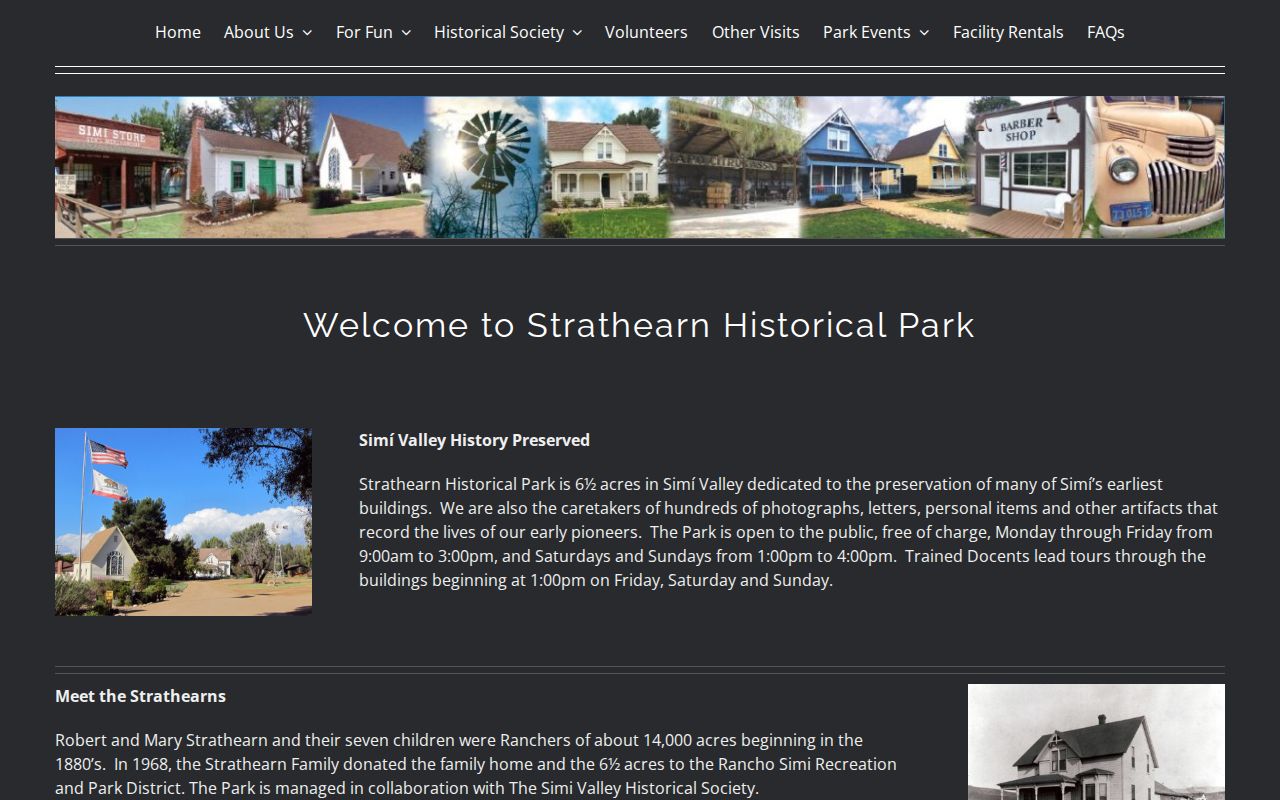
Local family context can suggest which surname, parcel, obituary, or organization record deserves the next check.
Simi Valley Previous Residents Evidence
Describe previous residents with the narrow claim each record supports. Two independent records can strengthen a weaker clue.
| Evidence | Strong claim supported | Necessary caution |
|---|---|---|
| Recorded deed with matching legal description | Named party held or transferred a recorded interest on a date | Does not prove occupancy; recording can lag execution |
| Census household schedule | Household was enumerated at a place on census day | Spelling and relationships can be wrong; public only through 1950 |
| Reverse-directory entry | Publisher associated a listed adult or phone with an address | Compilation lag, omissions, and boundary limits apply |
| Tax mailing address | Assessment correspondence went to an address | Could be an agent, trust, business, or different location |
| Permit application | Named applicant, owner, or contractor had a project role | Role and date specific; not a household list |
| Obituary or probate filing | Death, kin, heir, or contact facts were published or filed | Verify identity and separate allegation from order |
When records disagree, preserve both versions and state why one carries more weight. A legal description usually outranks a street match.
Simi Valley Six-Phase Case Notebook
A six-phase notebook keeps one address from becoming unlinked names. Record source, date, field, and unresolved question.
- Freeze the present parcel. Save situs, APN, tract, map, book/page, block/parcel, adjacent APNs, and latest DOC_NR, DOC_DT, and DOC_TYPE.
- Prove the current conveyance. Obtain the vesting deed and inventory parties, dates, capacity, legal description, and related documents.
- Walk backward. Search each grantee earlier, take the prior grantor, and confirm land identity by legal description rather than surname alone.
- Handle parcel evolution. Follow ghosted lots, adjacent book/page references, tract boundaries, land hooks, parent parcels, and recorded maps.
- Overlay people. Pair directories and census through 1950 with permits, newspapers, obituaries, probate, and organization records.
- Close gaps. Move from online indexes to a counter appointment, written request, library or archive reference, microfilm, mail form, or narrow CPRA request for an existing record.
Before 1873 Simi Valley Records
Ventura County was created in 1872 and began separate county government in 1873. Earlier Simi Valley land and court evidence may therefore sit in Santa Barbara County-era records, Mexican land-grant material, mission or parish sources, cemetery files, newspapers, probate, and early census schedules. Search the jurisdiction at the event date before assuming that a modern Ventura County index holds the whole trail.
When online searching stops, use the documented fallback routes.
- Online: Use county GIS, Assessor, Clerk-Recorder, court inquiry, library catalogs, and Museum ArchivesSpace.
- Counter: Recorder appointments are available in Ventura and Thousand Oaks; court, Museum, and Strathearn files use their research desks.
- Phone: Recorder 805-654-3665, Assessor 805-654-2181, Tax Collector 805-654-3744, City Clerk 805-583-6748, and Museum 805-653-0323 can identify the channel. Court phone searches are not processed.
- Written: Give the Recorder party, date span, APN, legal description, and document number. Give the Museum name, email, arrival date, surname, and date range.
- Mail: Court requests use the VSC form and a self-addressed stamped envelope to Hall of Justice, P.O. Box 6489, Ventura, CA 93006; applicable restricted files use the Oxnard center.
- Library or archive: Ask both libraries, the Museum, and the Historical Society for directories, microfilm, yearbooks, clippings, family files, and coverage.
- CPRA: Request an existing city permit index, card, annexation file, or export with a date range. CPRA usually brings a determination within ten days, with a limited fourteen-day extension; it does not create a house history.